Career Readiness Skills Checklist: 15 Skills Every College Student Needs
Here's something nobody tells you at graduation: you can walk out with a strong GPA and still sit in your first interview with no idea what to say. That gap — between what you learned in class and what an employer actually needs on day one — is the whole reason career readiness exists.
The good part? It's completely learnable. This career readiness skills checklist breaks down the 15 skills that matter most, grouped so you can spot where you're already strong and where you've got some catching up to do.
What Are Career Readiness Skills and Why Do They Matter Now?
So what are career readiness skills, really? They're the practical, transferable abilities that let you turn what you know into what you can do at work. They don't belong to any one major. A biology student and a marketing student both have to communicate clearly, work with people they didn't pick, and manage their time when everything's due at once. Those are career readiness skills, and every employer is quietly testing for them.
Here's the simplest way to think about it. Your degree proves you can learn. Your career readiness skills prove you can contribute. In an interview, the first is assumed the second they see your transcript. The whole conversation is really about the second.
That's the part most students miss. They pour four years into the thing that gets them in the door and barely touch the thing that gets them hired. It shows, too — study after study finds a real gap between how ready graduates feel and how ready employers actually find them, and it almost never comes down to technical knowledge. It comes down to these skills.
And the "now" matters more than it used to. Work has changed fast — remote teams, AI tools, roles that get reinvented every couple of years. The ability to adapt and keep learning is worth more today than any single piece of software you memorize this semester. That's exactly why building employability skills for career readiness while you're still in college — instead of scrambling after graduation — gives you such a head start.
The 15 Career Readiness Skills at a Glance
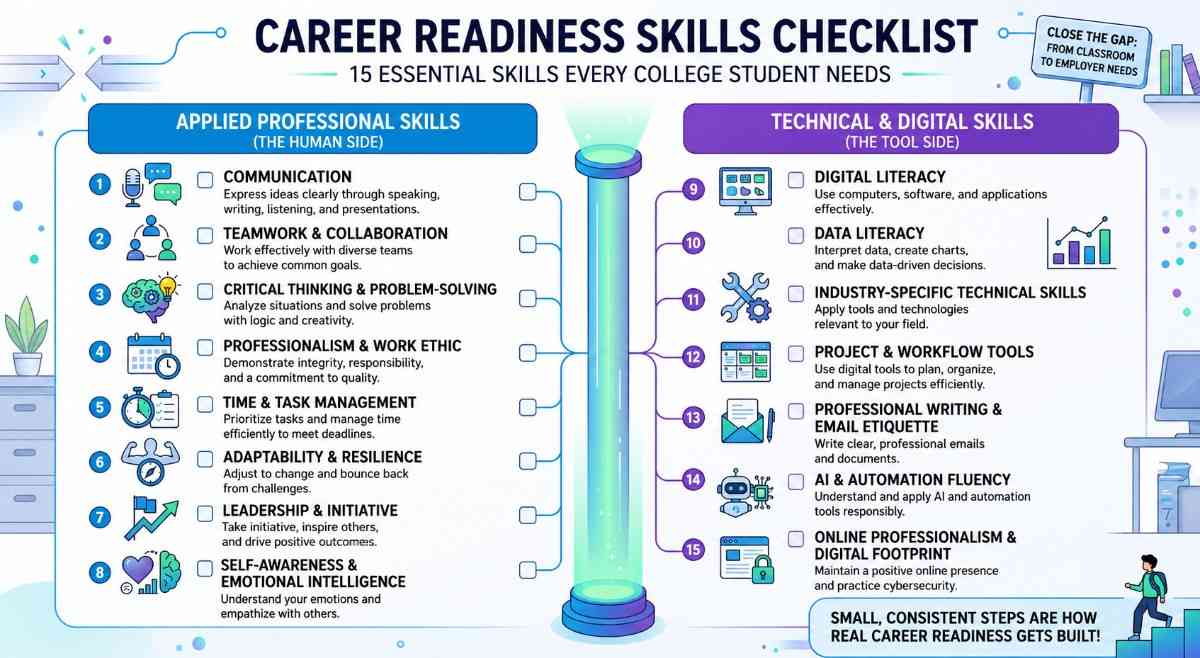
Before we dig in, here's the full map. This is your college and career readiness skills list, split into two halves: the human skills that make people want to work with you, and the technical skills that make you effective once they do. You need both.
Applied Professional Skills: From Classroom to Office
These are the skills hiding behind every job description that asks for a "team player" or a "self-starter." They're also the ones that separate the people who get offers from the people who just get interviews.
1. Communication. This means speaking clearly, writing without making people work for it, and — the part everyone skips — actually listening. In class, you communicate to earn a grade. At work, you communicate to be understood and to move things forward.
Example: A classmate misses a lecture, and your quick two-line explanation makes the topic click for them.
2. Teamwork and collaboration. Group projects feel like a punishment for a reason — they're a rehearsal for real work. Learn to split tasks fairly, deal with the teammate who disappears, and disagree without making it personal. Employers ask about this constantly.
Example: Your group splits the work fairly and everyone actually sticks to it — so no one's stuck doing it all the night before.
3. Critical thinking and problem-solving. This is your ability to look at a messy, unclear situation and choose a sensible way forward. School problems have an answer key. Real ones usually don't — and that's the skill.
Example: A question on the assignment isn't in the textbook, so you work it out step by step instead of giving up.
4. Professionalism and work ethic. Showing up on time, hitting deadlines, owning your mistakes, following through when nobody's watching. It sounds obvious. It's also the number one thing managers say new grads get wrong. Reliability is a skill, and it quietly makes people trust you with bigger things.
Example: You reply to the group chat and show up to meetings on time, every time, so people start counting on you.
5. Time and task management. Juggling five classes with five different deadlines is better training than it feels like. Learn to separate what's urgent from what's important, break big tasks into small ones, and protect your focus. A calendar and one simple to-do list will carry you a long way.
Example: You start the assignment a few days early, so one surprise doesn't turn into a panicked all-nighter.
6. Adaptability and resilience. Plans fall through, projects get cancelled, feedback stings. The people who thrive aren't the ones who never get knocked down — they're the ones who adjust and keep moving. Every setback in college is free practice for this.
Example: Your study group cancels last minute, so you switch to studying solo instead of losing the whole evening.
7. Leadership and initiative. You don't need a title to lead. Leadership here means noticing what needs doing and doing it, keeping a group moving, and taking responsibility for how things turn out.
Example: Your group is going in circles, so you say "okay, let's split it up like this" — and suddenly things start moving.
8. Self-awareness and emotional intelligence. Knowing your own strengths, gaps, and triggers — and reading the people around you. This is what lets you take criticism without getting defensive and work with people who are nothing like you. Quietly, it's one of the most valued skills at every level of a career.
Example: You know you focus best in the morning, so you save your hardest studying for then instead of fighting yourself at midnight.
Technical and Digital Skills: Thriving in a Digital-First Workplace
The eight skills above are timeless. These next seven are what make you effective in a modern, digital-first workplace from your very first week. You don't have to master all of them — but you should be comfortable and unafraid of the ones your field uses.
9. Digital literacy. The baseline: moving through email, cloud drives, video calls, and shared documents without friction. Employers assume it now, so any gap shows fast. If one common tool still makes you tense up, spend one quiet afternoon fixing that.
Example: Your group's notes live in a shared doc, and you're editing and commenting in it without a second thought while others are still finding the link.
10. Data literacy. You don't need to be a statistician. But you should be able to read a chart, make sense of a spreadsheet, notice when a number looks wrong, and use evidence to back up what you're saying. Nearly every field expects this at some level now.
Example: A classmate's slide shows a chart that makes a tiny change look huge, and you notice the scale is off before anyone else does.
11. Industry-specific technical skills. The real tools of your target field — design software for designers, lab techniques for scientists, coding languages for developers, CRM systems for sales. Pull up ten actual job postings for the role you want and note which tools keep showing up. That's your study list.
Example: Every posting for your dream role asks for Excel, so you spend a weekend actually learning it instead of hoping it won't come up.
12. Project and workflow tools. Modern teams run on shared task boards and project trackers. Getting comfortable with how tasks, deadlines, and handoffs move through these makes you useful on day one — before anyone has to slow down and train you.
Example: Your group uses a shared to-do board, and you keep your tasks marked done so everyone can see what's finished at a glance.
13. Professional writing and email etiquette. A clear, warm, well-structured email is a quiet superpower most graduates don't have. Write a subject line that says something. Get to the point in the first two lines. Match your tone to your reader. Do this well and you'll stand out among people who've been working for years.
Example: You email a professor with a clear subject line and a short, polite message — and get a helpful reply the same day.
14. AI and automation fluency. Using AI tools thoughtfully — to draft, summarize, research, and speed up routine work — while knowing their limits and checking their output instead of trusting it blindly. This is fast becoming a core part of employability skills for career readiness, not a bonus.
Example: You use an AI tool to draft an outline, then fact-check it and rewrite it in your own words instead of turning it in as-is.
15. Online professionalism and digital footprint. Your public profiles are part of your résumé whether you signed up for that or not. Clean up what an employer can find, build a professional presence on the platform your industry lives on, and think before you post. Managing your digital footprint is a real, checkable skill.
Example: Before applying for internships, you Google your own name, delete an old cringe-worthy post, and tidy up your profile so employers see the best version of you.
Final Thoughts
Nobody masters all 15 skills at once — and you're not supposed to. The students who walk into interviews with quiet confidence got there by practicing one skill at a time, in the ordinary moments college hands them: the group project, the part-time shift, the email to a professor.
That's the good news. You don't need a fancy course or a new internship to start — just the situations you're already in. So don't let this be another article you nod along to and forget. Scroll back up, score yourself on the checklist, and pick one skill to work on this week. Do that consistently, and by graduation you won't just have a degree. You'll have proof that you're ready. And if you want the full picture behind these skills — what career readiness means, why it matters, and how it's assessed — start with our complete guide to career readiness.