Career Readiness vs. Job Readiness: What's the Difference and Why It Matters in Hiring
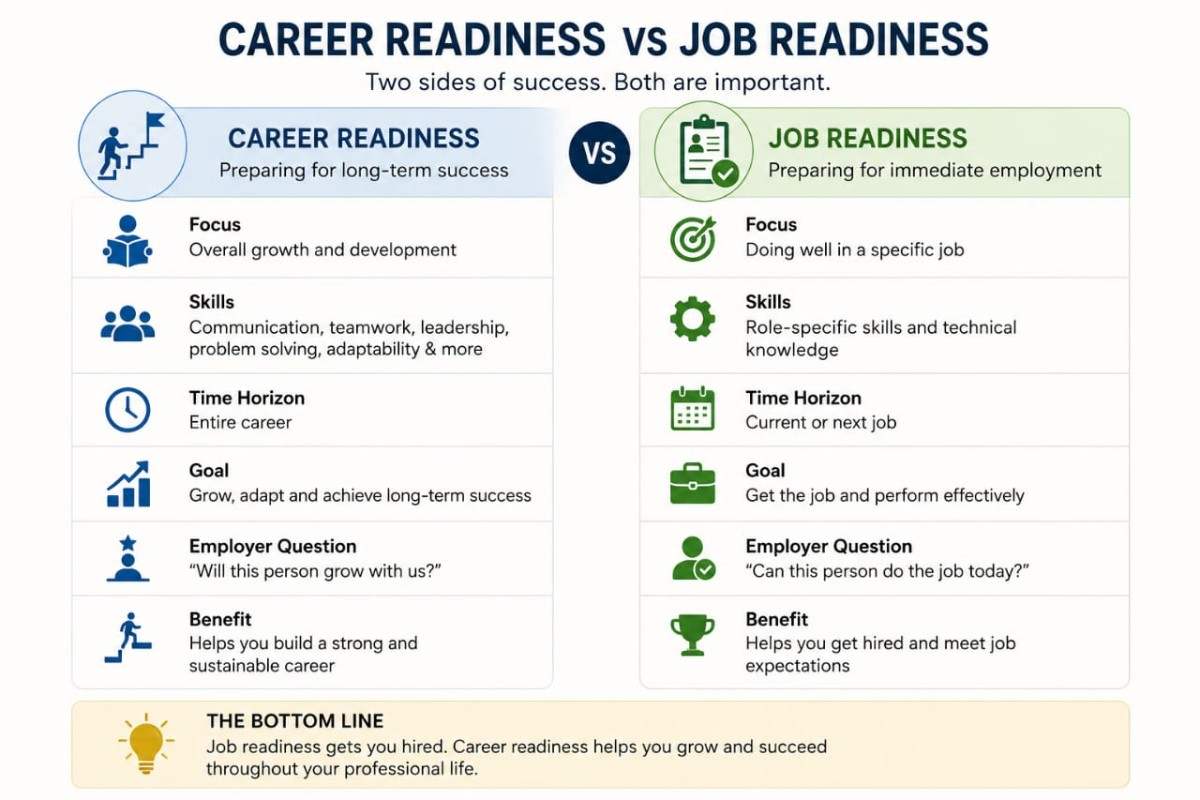
You completed your degree, earned certifications, and built a professional resume. Yet many graduates still struggle to get shortlisted, while others get hired but find it difficult to grow in their careers. The reason often comes down to understanding two important concepts: career readiness and job readiness. Although these terms are often used interchangeably, they serve different purposes. Job readiness helps you secure a role, while career readiness helps you succeed and advance throughout your professional journey.
What Is Career Readiness and Job Readiness?
Career readiness refers to the broad set of competencies that help students and professionals successfully navigate their careers over time. Job readiness focuses on the specific skills and knowledge required to perform a particular role successfully from day one.
Career Readiness vs Job Readiness: Quick Comparison
Why This Distinction Matters More in 2026: The Rise of Skills-Based Hiring
The line between these two terms used to be academic. Skills-based hiring made it practical.
- In 2019, roughly 73% of employers screened entry-level candidates by GPA. By 2026, that figure has dropped to about 42%.
- Around 70% of employers now use skills-based hiring for entry-level roles.
- Despite improved hiring projections for the Class of 2026, 55.5% of employers say graduate skills are only partially aligned with their needs.
Read those three data points together and the pain point at the top of this article explains itself: the screening layer of modern hiring tests job readiness (demonstrable, role-specific skills), while most student preparation — and most campus programming — builds career readiness (broad competencies). Students are entering a growing market and still getting filtered out, not because they lack skills, but because they're presenting the wrong kind of readiness at the wrong stage.
Why Career Readiness and Job Readiness Both Matter
Modern employers evaluate both types of readiness during the hiring process.
Employers Assess Job Readiness Through:
- Technical assessments
- Certifications
- Portfolio projects
- Work samples
- Practical assignments
Employers Assess Career Readiness Through:
- Behavioral interviews
- Internship experiences
- Group discussions
- Leadership examples
- Communication skills
Students who develop both are more likely to secure opportunities and succeed after being hired.
How Students Can Build Job Readiness and Career Readiness
Common Mistakes Students Make
What This Means for Placement Officers and Career Services
For career services teams, this distinction is a program design decision, not semantics.
Most campus programming over-indexes on career readiness — resume workshops, soft-skills seminars, mock interviews. All valuable, but the 55.5% skills-alignment gap shows what's missing: the screening layer tests job readiness, and campuses mostly teach career readiness. Closing the gap means sequencing both:
- Map top recruiter roles to skill requirements and publish role-specific readiness tracks, not just generic workshops.
- Push demonstrable output — micro-projects, externships, portfolio artifacts — because skills-based hiring rewards evidence.
- Reframe soft-skills programming as evidence-building: don't just teach communication; engineer situations students can cite in behavioral interviews.
We've covered the institutional playbook in detail in our guide on how placement officers can prepare students for career success.
The Bottom Line
Career readiness and job readiness aren't competing priorities — they're two clocks running at different speeds. Job readiness answers the question employers ask first ("can you do this role now?"). Career readiness answers the question they ask forever after ("can you keep growing here?").
Get specific for the role in front of you. Stay broad for the career ahead of you. Small difference — big hiring implications.
FAQs
What is job readiness?
Job readiness is the ability to perform effectively in a specific job from day one. It includes the technical skills, industry knowledge, practical experience, and workplace behaviors employers expect for a particular role. Job readiness helps candidates meet job requirements, pass hiring assessments, and contribute quickly in the workplace.
Is job readiness the same as employability?
Not quite. Employability is closer to baseline work readiness — the general behaviors and soft skills that make you hireable anywhere. Job readiness adds role-specific skills for one particular position on top of that foundation.
Which comes first: job readiness or career readiness?
Prioritize job readiness on your timeline — it determines whether you get shortlisted. But build career readiness through that process via internships, projects, and team experiences, since those competencies determine how far you advance after you're hired.
What is the main difference between career readiness and job readiness?
Time horizon and scope. Career readiness is a broad, transferable set of competencies for an entire working life; job readiness is the specific, demonstrable ability to perform one role from day one.
Do employers test career readiness or job readiness?
Both, at different stages. Screening and assessments largely test job readiness (skills, tools, certifications), while behavioral interviews and probation periods evaluate career readiness competencies like communication, adaptability, and teamwork.