Employability Skills Gap in India: What It Means for Universities in 2026
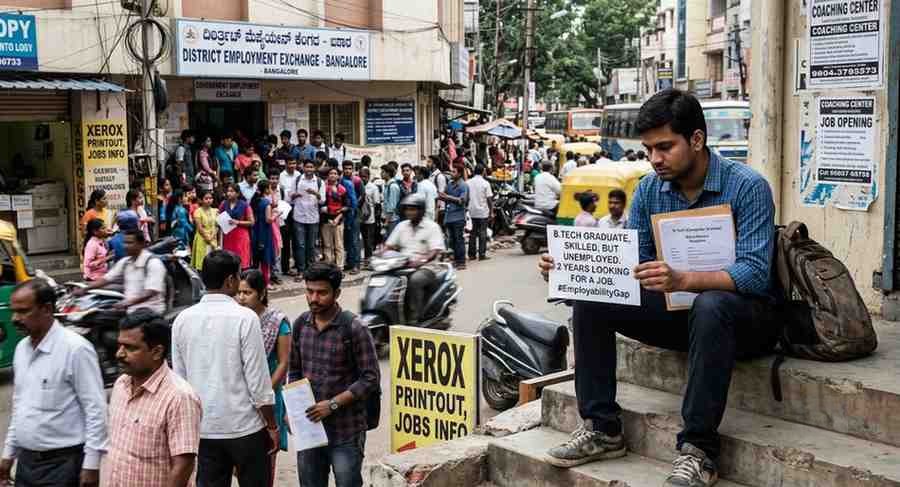
The employability skills gap in India is the gap between what universities certify through a degree and what employers actually need on day one of a job. Depending on the report, only 42% to 56% of Indian graduates are assessed as employable — meaning a large share of students who clear their exams still cannot step into a role without retraining. For universities, this is no longer just a student problem: graduate employability now directly shapes NIRF rankings, NAAC accreditation, recruiter trust, and enrolment. Closing the gap has become an institutional performance metric, not a placement-cell afterthought.
For decades, Indian higher education measured itself by enrolment, examinations, and infrastructure. That era is ending. Employers, regulators, and families are all asking the same sharper question: does a degree from this institution actually lead to a job? This guide unpacks the employability skills gap specifically through a university's lens — the data, the accreditation stakes, the causes institutions can actually control, and a practical playbook to turn placement outcomes into a competitive advantage.
What "Employability" Really Measures (From an Institution's View)
Universities often equate employability with placement percentage. Recruiters measure something broader. Most large-scale employability assessments in India evaluate four dimensions, and a graduate must clear a minimum bar on all four to count as employable:
The implication for universities is significant: a student can score distinctions across every semester and still be classified as not employable because of a single weak dimension — most often communication or applied practice. This is why raising placement numbers is rarely about teaching more content. It is about building the applied, behavioural, and communication layers that examinations never test.
The gap has three shapes on campus
Why Employability Is Now an Institutional Accountability Problem
This is the shift most articles miss. The employability gap has moved from being a student's burden to being an institution's mandate — pushed there by three simultaneous forces.
Root Causes Universities Can Actually Control
Beyond Placement Cells: Talent Intelligence and Role-Fit Matching
Most universities focus on training students and increasing internships, but the greater opportunity lies in matching students to roles that align with their aptitude, interests, and behaviour. A resume and CGPA reveal only a small part of a student's potential, while Applicant Tracking Systems (ATS) often filter candidates based on keywords rather than capability. AI-powered talent intelligence and psychometric assessments solve this by evaluating interests, cognitive ability, aspirations, and behavioural work indicators to identify the roles where students are most likely to succeed. By integrating these insights from admission through placement, universities can improve placement outcomes, reduce course mismatches and attrition, and provide recruiters with richer, role-fit profiles instead of keyword-focused resumes, transforming the placement cell into a talent intelligence engine for the future.
FAQs
What percentage of Indian graduates are employable?
Estimates range from about 42% (assessment-based studies like the Mercer-Mettl India Graduate Skill Index) to around 56% (survey-based reports like the India Skills Report 2026). No major report shows a strong majority of graduates as readily job-ready without upskilling.
Why is graduate employability important for universities specifically?
Because it now directly affects institutional standing. Graduate outcomes carry significant weight in NIRF rankings, feed into NAAC and NBA accreditation, and influence recruiter trust and admissions demand. Employability has become a core performance metric, not just a placement-cell concern.
How does NEP 2020 affect employability in higher education?
NEP 2020 pushes institutions toward mandatory internships, vocational exposure, multidisciplinary flexibility, and the integration of AI, data, and analytics into curricula — all aimed at aligning graduate skills with real labour-market demand.
What are the main causes of the employability gap in Indian universities?
The primary causes are outdated curricula, an emphasis on theory over applied practice, weak industry-academia collaboration, poor communication-skill development, and the near-absence of early career guidance to match students with well-suited paths.
Which streams have the highest and lowest employability in India?
Computer Science and IT graduates report the highest employability (roughly 78–80%), driven by demand in AI and data roles. Core science, arts, and humanities streams — and non-CS engineering branches — typically report lower employability, largely due to weaker applied-skill integration.
How can a university improve its graduates' employability?
Through industry-co-designed curricula, mandatory experiential learning, communication training as a core subject, early and structured career guidance, transparent outcome reporting, and aptitude-based role matching that places students where they are most likely to succeed.
Can psychometric or AI-based assessment help universities close the gap?
Yes. Aptitude, interest, and behavioural assessments let institutions match students to well-suited roles, correct course mismatches early, improve placement conversion, and give recruiters fit-based profiles rather than keyword-driven resumes — especially when used from the point of admission.