Is AI Making Students Better Thinkers, or Just Better at Finding Answers?
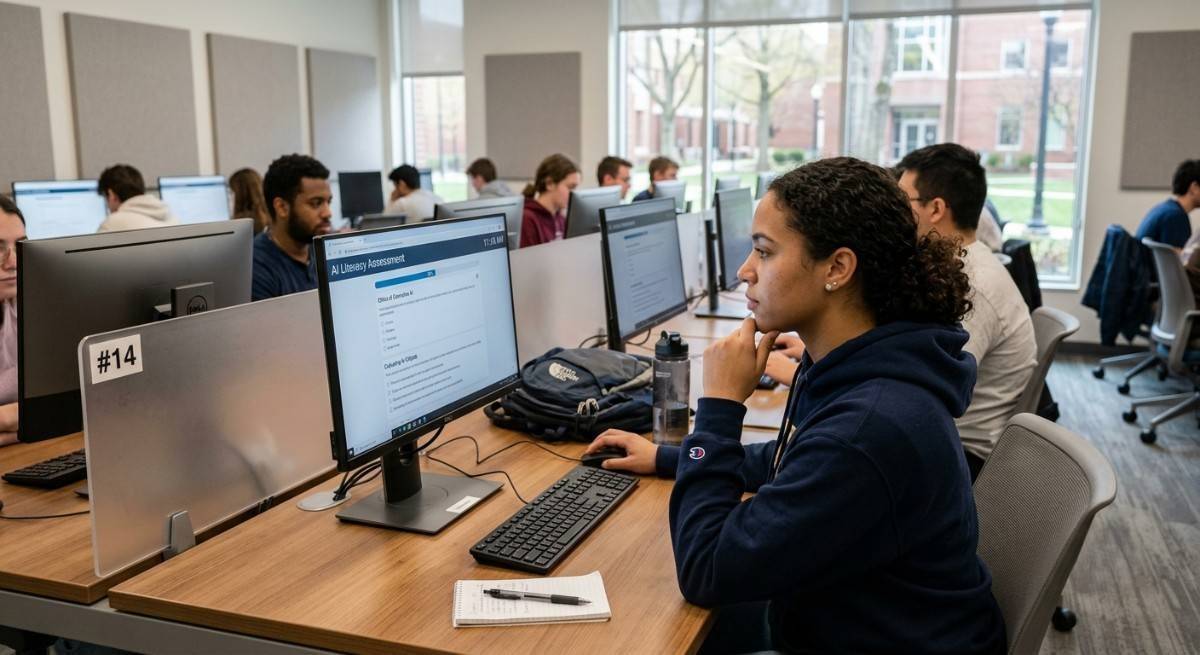
A student submits an assignment with a clear argument, well-organised paragraphs and convincing explanations. The work looks strong, but how much of that reasoning belongs to the student? As generative AI becomes part of academic work, this question is becoming harder for colleges to answer. Students can use AI to explore ideas, understand difficult concepts and improve their writing. They can also rely on it so heavily that the final assignment reveals very little about what they understand. The issue is not simply whether students should use AI. It is whether the way they use it helps them think more effectively.
What Does the Research Actually Say?
A systematic review published in Frontiers in Psychology in June 2026 examined 89 peer-reviewed studies published between 2024 and 2026 on generative AI and higher-order cognitive skills among university students. The review reported positive outcomes in 40.4% of the studies, while 23.6% reported mixed or conditional outcomes. The researchers also found that more than half of the studies did not specify a pedagogical strategy. These findings suggest that the relationship between generative AI and higher-order thinking is not straightforward. Outcomes vary according to how AI is used, how learning activities are designed and what students are expected to achieve.
Read the systematic review in Frontiers in Psychology.
One important distinction: these percentages describe the findings reported by the studies included in the review. They do not mean that AI improves critical thinking for a particular percentage of all students. The more useful question for colleges is this: What conditions help students use AI without outsourcing the thinking they need to develop?
When AI Can Support Critical Thinking
Critical thinking involves evaluating information, examining assumptions, comparing explanations and reaching conclusions based on evidence. Generative AI can support these activities when students use it to explore a problem rather than simply obtain a finished answer.
Consider a student researching why a business has experienced a decline in sales. The student could use AI to generate several possible explanations. They could then investigate those explanations, compare them with actual data and identify which conclusions the evidence supports. In this situation, AI expands the range of ideas available for consideration. The student remains responsible for evaluating those ideas. AI can also help students explore counterarguments, receive alternative explanations and identify areas they need to investigate further.
However, access to more information does not automatically lead to better reasoning. Students still need to decide whether the information is reliable and how it applies to the problem they are solving.
When AI Can Replace the Thinking Students Need to Practise
Now consider a different situation. A student receives an assignment, enters the question into an AI tool and submits the generated response with minimal review. The result may be well-written, but the student may not have examined the evidence, evaluated the argument or developed an independent understanding of the problem.
This creates a challenge for educators. A polished submission is not necessarily proof of deep understanding, but using AI does not automatically mean a student has learned nothing. The distinction depends on how the tool was used and what the assignment was designed to assess. If the objective is to develop independent reasoning, students need opportunities to practise that reasoning. If the objective is to learn how to use AI responsibly in a realistic task, the assessment needs to evaluate that capability instead.
The Problem With Assessing Only the Final Answer
Traditional assignments often focus heavily on the final product. An essay is evaluated through its argument and evidence, while a project is judged by its outcome. These approaches can still provide useful evidence. However, when students have access to generative AI, educators may need to think more carefully about which parts of the learning process they need to observe.
A strong final answer may not reveal whether a student can explain the reasoning behind it. At the same time, an AI-assisted answer may reflect meaningful learning if the student has critically evaluated and improved the output. The solution is not to assume that every AI-assisted assignment is either successful learning or academic misconduct. It is to design assessments that make the intended learning outcomes clearer.
Four Ways Colleges Can Assess Critical Thinking More Effectively
Ask students to explain their reasoning. After an assignment, students can explain why they selected a particular approach, what evidence informed their decision and which alternatives they considered.
Ask students to evaluate an AI-generated response. Give them a response that contains claims requiring verification. Ask them to identify weaknesses, check the supporting evidence and explain how they would improve it.
Introduce unfamiliar problems. Students should have opportunities to apply their knowledge to new situations rather than simply reproduce familiar answers. Their reasoning and ability to adapt can provide useful evidence of understanding.
Assess revision and reflection. Ask students to explain how their thinking changed after receiving feedback or reviewing additional evidence. Where AI use is permitted, they can also describe which suggestions they accepted or rejected and why.
These approaches do not eliminate every assessment challenge. They can, however, give educators more insight into how students approach problems and make decisions.
Should Colleges Ban AI to Protect Critical Thinking?
A blanket ban may be appropriate for some assessments, particularly when the purpose is to evaluate unaided performance. But it is not the only possible response.
Different learning objectives require different assessment conditions.
If a college wants to determine whether a student can perform a calculation independently, an assessment without AI assistance may be appropriate. If the objective is to evaluate whether students can use AI responsibly to solve a realistic workplace problem, prohibiting AI would prevent educators from measuring that capability.
The important step is to define the objective before choosing the assessment method.
Colleges should communicate when AI use is permitted, which parts of an assignment must reflect independent work and when students need to disclose their use of AI. They should also recognise that independent reasoning and responsible AI use are related but distinct capabilities. Both may matter, and each may need to be assessed differently.
Why This Matters Beyond Academic Performance
Critical thinking is relevant long after graduation. Employees need to interpret information, evaluate recommendations and make decisions when the available evidence is incomplete.
A graduate reviewing an AI-generated report still needs to decide whether its conclusions are justified. Someone analysing data must understand what the evidence supports and what remains uncertain. These capabilities matter across disciplines, although their practical application differs from one role to another.
For colleges, this reinforces the importance of understanding more than a student's ability to produce a convincing final answer. Institutions need opportunities to evaluate how students apply knowledge, examine evidence and make decisions. Those insights can help educators identify where additional practice would be useful before students enter the workplace.
From Assessment Scores to a Clearer Understanding of Students
No single assignment can capture every dimension of a student's thinking ability. A more informative picture comes from multiple forms of evidence, including practical tasks, structured questioning, project work and opportunities to explain decisions.
Assessment results should help educators understand specific capabilities and development needs rather than become permanent labels for students.
ChangeBegins focuses on talent intelligence and assessment, making the broader question of understanding individual capabilities particularly relevant. For colleges, the opportunity is to connect evidence about student strengths and development needs with meaningful preparation for future work.
The goal is not to assess students simply because assessment is possible. It is to understand what they can do and where further learning could make a difference.
The Better Question Is How Students Use AI
The research does not support a simple conclusion that generative AI always improves critical thinking or inevitably weakens it. Instead, the evidence points towards the importance of context, instructional design and the way students engage with their work.
AI can support exploration, comparison and feedback. It can also make it easier to bypass the reasoning that learning activities are intended to develop. Colleges therefore need to think carefully about what they want students to learn and what evidence would demonstrate that learning.
The real challenge is not whether students can find an answer with AI. It is whether they can question that answer, defend their decisions and think clearly when the tool cannot do the thinking for them.