Skill Mapping vs. Traditional Resumes: Redefining Campus Recruitment for 2026
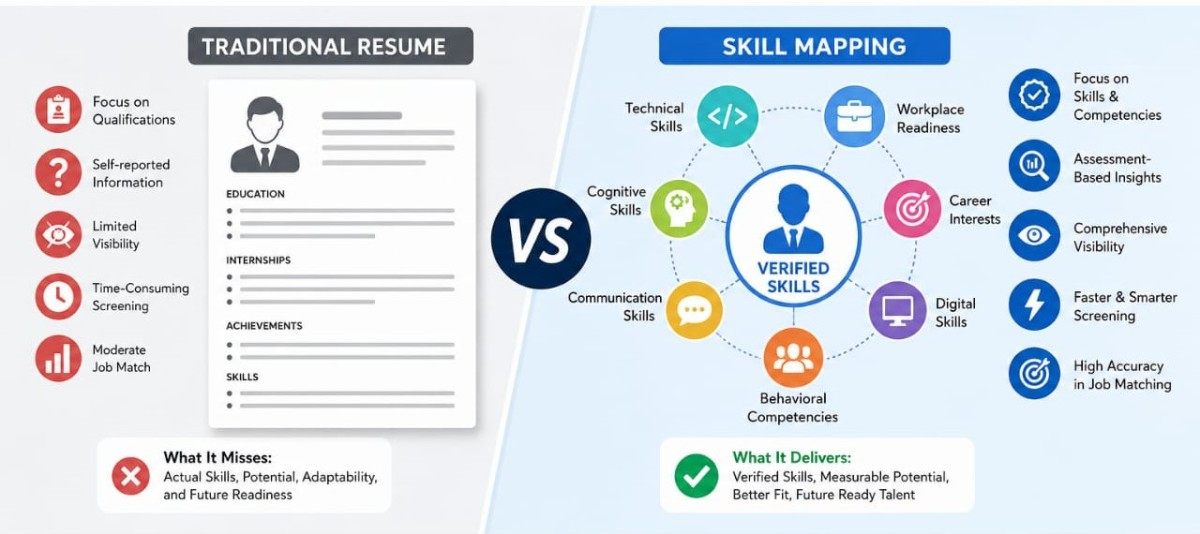
Campus recruitment is changing rapidly. Employers are no longer satisfied with reviewing resumes that only highlight academic achievements and internship experiences. Instead, organizations are increasingly adopting skill mapping to identify graduates who possess the competencies needed to succeed in today's workplace. As the future of work evolves, recruiters are shifting toward skills-based hiring, focusing on capabilities rather than credentials alone. This transition is helping employers make better hiring decisions while enabling colleges to improve student employability and placement outcomes.
The growing adoption of career readiness assessments, competency mapping, and AI-powered talent assessments signals a new era in campus recruitment—one where verified skills matter more than resume claims.
Traditional Resume vs Skill Mapping
The Flaws of the Chronological CV in Modern Early-Career Hiring
For decades, resumes have been the primary screening tool for employers. However, they present several limitations in today's competitive hiring environment.
Limited Visibility into Actual Skills
A student may list communication, leadership, or technical skills on a resume, but recruiters have little evidence to verify proficiency levels.
Credentials Over Competence
Many hiring decisions continue to be influenced by degrees, grades, and college reputation. However, these factors often fail to predict workplace performance.
Inconsistent Candidate Comparisons
Different resume formats and writing styles make objective candidate comparison difficult, especially when recruiters review hundreds of applications.
Hidden Potential Remains Unnoticed
Critical workplace competencies such as problem-solving, adaptability, resilience, and collaboration are often underrepresented in resumes.
What is Skill Mapping? Transitioning from Credentials to Capabilities
Skill mapping is the process of identifying, assessing, and aligning an individual's capabilities with industry requirements and career opportunities.
Rather than focusing on educational history alone, skill mapping evaluates what a student can actually contribute in a workplace environment.
The Role of Artificial Intelligence: AI Inclusion in Skill Mapping
Artificial Intelligence is significantly improving how skills are assessed, analyzed, and matched with career opportunities.
How AI Enhances Skill Mapping
Data-Backed Benefits: Why Campus Recruiters are Leaving Resumes Behind
The shift toward skill mapping is supported by several measurable benefits.
Better Hiring Decisions
Verified skill data enables recruiters to identify candidates who possess the competencies required for success.
Faster Recruitment Processes
Standardized skill profiles allow recruiters to compare candidates quickly and objectively.
Stronger Diversity and Inclusion
Skills-based hiring reduces the influence of academic pedigree, creating more equitable opportunities.
Improved Placement Outcomes
Students receive targeted guidance based on their strengths and development needs, increasing employability.
Future Workforce Readiness
Organizations can identify graduates who demonstrate adaptability, continuous learning, and growth potential.
Empowering Campus Placements with ChangeBegins
As employers increasingly adopt skills-based hiring practices, colleges need technology that provides deeper insights into student potential.
ChangeBegins helps institutions move beyond traditional resumes through AI-powered career readiness solutions. By combining assessment intelligence with actionable recommendations, ChangeBegins enables colleges to create industry-ready graduates and strengthen placement performance.
Conclusion
The future of campus recruitment is shifting from resumes to skills. While traditional resumes continue to provide useful background information, they no longer offer the comprehensive insights employers need when evaluating talent. Skill mapping provides a data-driven approach to assessing competencies, identifying potential, and improving job-role alignment. Combined with AI-powered assessments, it enables institutions and employers to make smarter recruitment decisions.
FAQs
1. What is the main difference between skill mapping and a traditional resume?
A traditional resume primarily highlights educational qualifications, experiences, and achievements. Skill mapping, on the other hand, systematically evaluates and measures a student's competencies, strengths, workplace skills, and career readiness to provide a more accurate picture of employability.
2. How does AI assist in the skill mapping process during recruitment?
AI analyzes assessment data, identifies strengths and skill gaps, generates personalized career recommendations, predicts job-role fit, and helps recruiters match candidates with relevant opportunities more efficiently and objectively.
3. Why are degrees losing their importance compared to skills-based hiring in 2026?
Employers increasingly prioritize practical competencies, adaptability, problem-solving abilities, and workplace readiness. Skills-based hiring provides stronger evidence of a candidate's ability to perform successfully in a role than academic credentials alone, making it a preferred recruitment approach in 2026.