An AI Screens Your Students Before a Recruiter Ever Sees Them. Are They Ready?
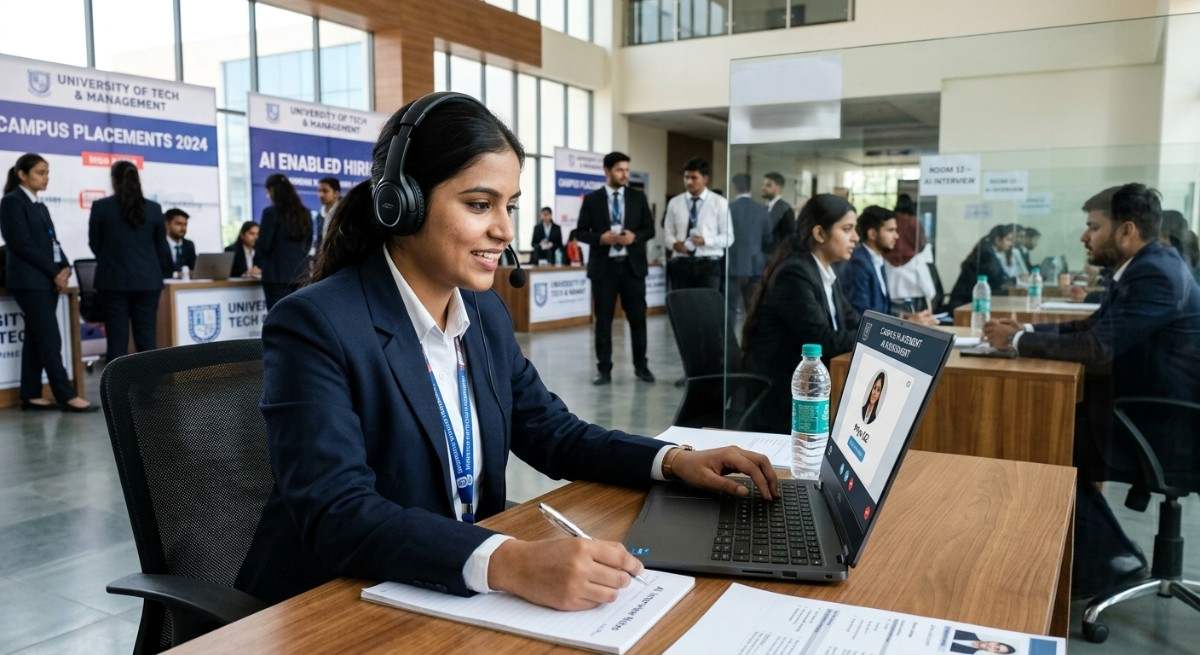
AI now sits at the front of campus placements. Recruiters use AI-powered platforms to run online assessments, screen resumes, and even conduct video interviews — filtering thousands of students before any human is involved. These systems evaluate not just answers but communication patterns, structure, and clarity. For colleges, this means preparing students for AI-driven screening at scale is no longer optional; it's the new first hurdle of every placement drive.
Picture the first round of a campus drive in 2026. There's no recruiter in the room. There may not be a room at all. Instead, an AI system administers an online assessment, screens the resume, and in a growing number of cases runs a recorded video interview — scoring each student before a single human recruiter looks at anyone.
For students, that's a new kind of pressure. For placement teams, it's a new responsibility: preparing an entire cohort not just for interviews, but for the algorithms that now stand in front of them. Here's what's actually happening, and what your college can do about it.
How AI Has Taken Over the First Round
Campus hiring in 2026 has become assessment-led and data-driven, with recruiters using AI-powered hiring platforms, online assessments, and remote interviews to identify talent from thousands of applicants. The volume is the point: when a company receives thousands of applications, AI is how it gets from thousands to a shortlist.
That means the first thing that judges your student usually isn't a person. It's a system running an aptitude test, a coding assessment, a resume scan, or a recorded interview — and each one has its own rules for who passes.
What the AI Is Actually Measuring
This is where students — and the colleges preparing them — need to understand the machine.
In AI-assisted video interviews, students answer predetermined questions on camera, and the system may analyse factors like word choice, communication patterns, and response content. It isn't only what a student says — it's how clearly and how structurally they say it.
In online assessments, AI scores aptitude, logical reasoning, and coding against consistent benchmarks. In resume screening, it matches profiles against role criteria in seconds. The common thread: these systems reward clarity, structure, and demonstrable capability — and they filter out students who have the knowledge but can't present it in the form the system expects.
That's the trap for a lot of capable students. They know the material, but they've never practised communicating it to a camera or performing under a timed, AI-scored assessment. The gap isn't knowledge. It's readiness for the format.
Why This Is a College Problem, Not Just a Student One
It would be easy to leave this to students and a few YouTube tutorials. That's a mistake — because the students who most need this help are the ones least likely to find it on their own.
If AI screening is the first filter of every drive, then a college that doesn't prepare its cohort for that filter is losing students before the interview stage every single time — and often without knowing why. The rejection looks like "didn't clear the online round," but the real cause is that no one prepared the student for how an AI round actually works.
Preparing a whole cohort for this — consistently, at scale — is exactly the kind of readiness work placement teams now own. And it starts with knowing where each student stands. This is the same principle running through the campus recruitment trends of 2026: the drives are won or lost long before the final interview.
How Colleges Can Prepare Students for AI-Driven Placements
The good news: preparing for AI screening is learnable, and it maps neatly onto readiness work colleges should be doing anyway.
Measure readiness in the formats AI uses. Students need practice with timed online assessments and recorded responses, not just classroom tests. A structured workforce readiness assessment that mirrors real screening formats shows you who can perform under those conditions and who freezes.
Find the students who'll get filtered out — before the recruiter does. A cohort-level skill gap assessment surfaces who needs aptitude practice, who needs coding support, and who needs help communicating clearly and concisely — the exact things AI rounds test.
Train communication for the camera and the clock. Since AI weighs structure and clarity heavily, teach students to answer in clear, structured form (the STAR approach works well because AI systems are built to parse it), to speak clearly, and to stay composed in timed, recorded conditions.
Build demonstrable capability, not just knowledge. AI screens for evidence a student can do the work. The colleges that prepare students to show capability — clearly, under assessment conditions — are the ones whose students clear that crucial first round. This is what genuine readiness for what employers screen for looks like in an AI-first drive.
How ChangeBegins Helps
ChangeBegins helps placement teams prepare students for exactly the capabilities AI screening rewards — aptitude, technical skill, and clear, structured communication. By measuring readiness early, in realistic formats, colleges can see who's ready for AI-driven rounds and who needs support, then close the gap before drives begin.
The assessment framework has been validated by a leading university's research lab, and you can start with a focused pilot on a single cohort.
Frequently Asked Questions
How is AI used in campus placements?
Recruiters use AI to run online aptitude and coding assessments, screen resumes, and conduct recorded video interviews — filtering large applicant pools down to a shortlist before human recruiters are involved.
What does AI look for in a video interview?
AI-assisted interviews may analyse word choice, communication patterns, structure, and the content of responses — rewarding clear, well-structured, composed answers over rambling or unstructured ones.
Can students prepare for AI-driven placement rounds?
Yes. Practising timed online assessments and recorded responses, answering in a clear structured format (such as STAR), and building demonstrable skills all help students clear AI screening.
Why should colleges prepare students for AI screening?
Because AI screening is now the first filter in most drives. Colleges that don't prepare students for it lose capable candidates at the online round — often without understanding why.
Does AI screening replace human recruiters?
Not entirely. AI typically handles early screening and assessment at scale, while human recruiters focus on later interview stages. Students need to clear the AI round to reach the human one.
How can colleges prepare a whole cohort at scale?
By measuring readiness in the formats AI uses, identifying gaps at the cohort level, and targeting practice — timed assessments, recorded interviews, and structured communication — where students need it most.