Your Students Are Being Judged on Skills. Is Your College Still Preparing Them for Degrees?
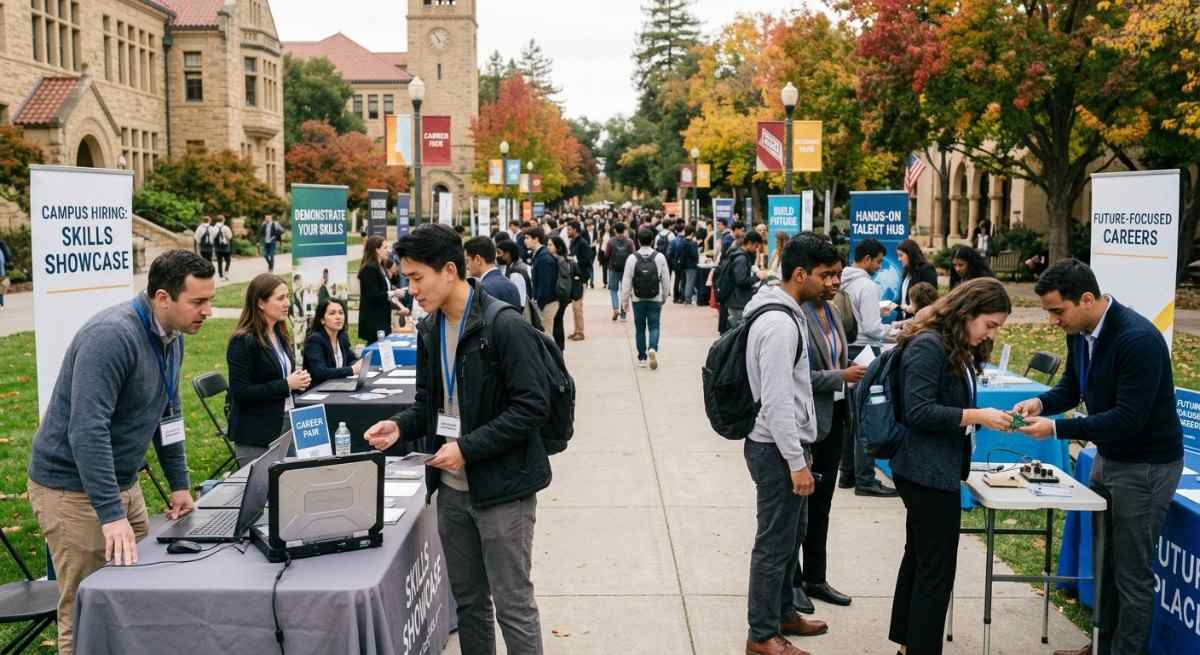
Skills-first hiring is a recruitment approach where employers evaluate candidates on demonstrated skills — through assessments, projects, and portfolios — rather than degree or CGPA alone. In India, it's gaining ground fast, but adoption is uneven: most colleges believe corporates have already made the shift, while most corporates are still mid-transition. For colleges, the real task isn't celebrating the trend — it's making sure students can prove the skills employers now screen for.
Every placement conversation in 2026 eventually arrives at the same phrase: skills-first hiring. Colleges talk about it. Employers talk about it. Reports are written about it. But underneath the agreement sits a gap that should concern every placement team in the country — and almost no one is naming it.
Here it is. According to HirePro's State of College Hiring in India 2026, 96% of colleges believe corporates have already embraced skills-first hiring — yet only 21% of corporates have fully adopted it, and 51% still allow CGPA to influence their decisions.
What Skills-First Hiring Actually Means
Let's define it plainly, because the term gets thrown around loosely.
Skills-first hiring is a recruitment philosophy where employers judge candidates on demonstrable capability rather than academic credentials alone. It doesn't mean degrees are irrelevant. It means a degree is no longer sufficient on its own.
In practice, skills-based hiring means evaluating students through coding assessments, aptitude tests, simulations, portfolios, and demonstrated capabilities instead of relying primarily on college reputation or CGPA. The question has shifted from "where did you study?" to "show me what you can do."
Why the Shift Is Happening Now
This isn't a fashion. Three forces are driving it, and all three are permanent.
The first is AI and automation reshaping entry-level work. When routine technical tasks get automated, employers need people who can apply judgment, solve unfamiliar problems, and adapt — capabilities a degree certificate simply doesn't measure.
The second is the job-readiness problem employers keep running into. The same HirePro research found a gap that should stop every college in its tracks: only 9% of corporates say fresh graduates are job-ready on Day 1, while 68% of students believe they are. When employers can't trust the degree to signal readiness, they start testing for it directly.
The third is simple economics. Removing rigid CGPA filters widens the qualified candidate pool substantially, giving recruiters access to capable students they'd otherwise have screened out on a number. Skills-first hiring isn't just fairer — it's better business.
The Perception Gap Is the Real Story
Now back to that mismatch, because it's where colleges get caught out.
If a college believes employers are fully skills-first, it may assume its own students are being judged purely on capability — and relax on the credentials-and-readiness work that still matters. Meanwhile, the employer on the other side of the table is running a hybrid model: skills assessments and CGPA, and a hard look at whether the student can actually communicate and apply what they know.
The colleges that thrive in this environment aren't the ones with the strongest opinions about skills-first hiring. They're the ones who prepare students to prove skills regardless of where any individual employer sits on the adoption curve. That means building — and being able to evidence — real, demonstrable student capability, not assuming the market will reward potential.
What Skills-First Hiring Means for Your Placement Strategy
If employers are moving — however unevenly — toward judging students on demonstrated skill, then the college's job is to make that skill visible and real. In practice, that comes down to three shifts.
Measure the right things. Academic scores don't tell you whether a student can pass a skills assessment, solve an applied problem, or hold a professional conversation. A structured workforce readiness assessment surfaces the capabilities employers now test for — so you're measuring what the market measures.
Find and close the gaps. Once you can see where students stand, a cohort-level skill gap assessment shows exactly who needs what — coding practice, communication coaching, problem-solving development — so preparation is targeted, not generic.
Build evidence, not just ability. Skills-first employers want proof: projects, portfolios, assessment results, demonstrated capability. Help students accumulate that evidence through their college years, and they walk into any drive — skills-first or hybrid — able to show, not just claim.
This is also the throughline connecting the wider campus recruitment trends of 2026: every major shift rewards the student who can demonstrate capability, and the college that can prove it.
How ChangeBegins Helps Colleges Get Skills-First Ready
ChangeBegins helps colleges prepare students for exactly the capabilities skills-first employers screen for — technical, cognitive, communication, and behavioural. By measuring readiness early and making gaps visible, placement teams can build demonstrable skill across a cohort, not hope it's there when recruiters arrive.
The assessment framework has been validated by a leading university's research lab, and you can start with a focused pilot on a single cohort before wider rollout.
Frequently Asked Questions
What is skills-first hiring?
It's a recruitment approach where employers evaluate candidates on demonstrated skills — via assessments, projects, and portfolios — rather than degree or CGPA alone. Degrees still matter, but they're no longer sufficient on their own.
Has India fully shifted to skills-first hiring?
Not yet. Per HirePro's 2026 research, only about 21% of corporates have fully adopted skills-first hiring, while 51% still allow CGPA to influence decisions and many are mid-transition — so most employers run a hybrid model.
What's the difference between skills-first hiring and degree-based hiring?
Degree-based hiring uses academic credentials and CGPA as the primary filter. Skills-first hiring prioritises demonstrable capability — what a candidate can actually do — though most employers currently combine both.
Why are employers moving to skills-first hiring?
Because AI is reshaping entry-level work, because a large gap exists between how job-ready students believe they are and how ready employers find them, and because dropping rigid CGPA filters expands the pool of capable candidates.
How can colleges prepare students for skills-first hiring?
By measuring readiness across the capabilities employers test for, identifying and closing skill gaps at the cohort level, and helping students build demonstrable evidence — projects, portfolios, assessment results — not just academic scores.