The Career Readiness Gap: Why Employers Say Graduates Aren't Job-Ready in 2026
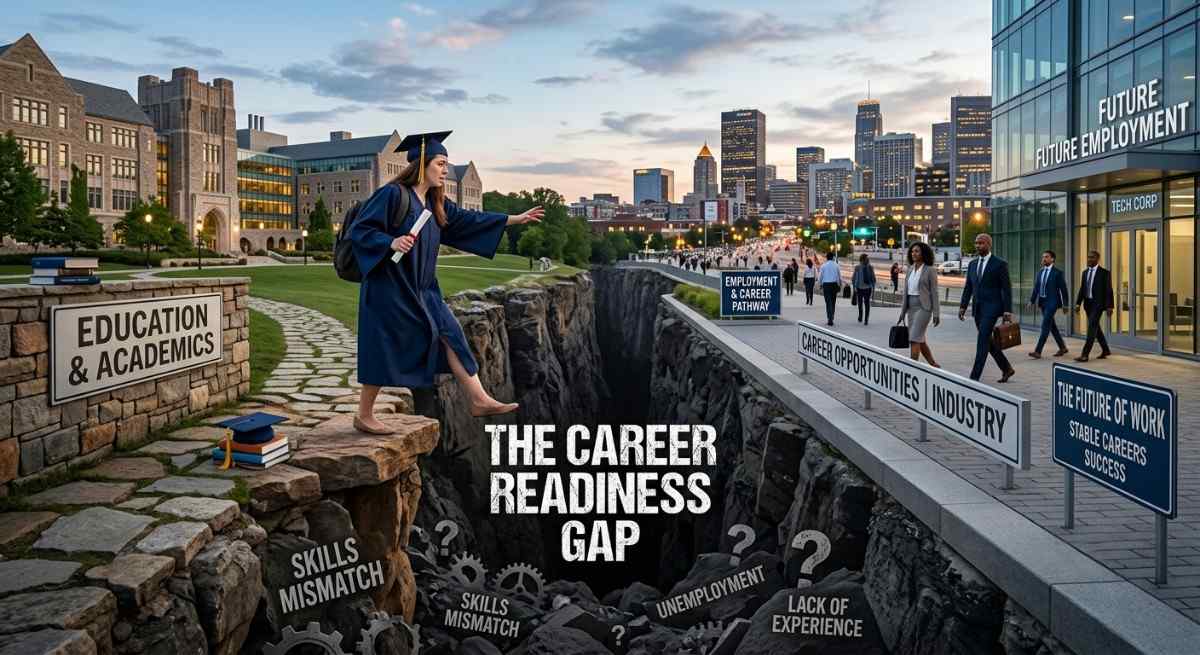
A graduate walks out of an interview convinced it went well. The recruiter walks out unconvinced. Multiply that moment across an entire hiring season and you get the defining problem of entry-level hiring in 2026: according to the 2026 State of Higher Ed Report, only 37% of recruiters believe today's college graduates are prepared for the workforce — while 84% of students believe they're ready.
That's a 47-point disagreement about the same person, holding the same degree, sitting in the same interview. It isn't a talent shortage, and it isn't graduate arrogance. It's the career readiness gap — a structural disconnect between what colleges teach, what students believe counts as "ready," and what employers actually screen for. This article breaks down how wide the gap has become, why it exists, what it costs everyone involved, and what each side can realistically do to close it.
What Is the Career Readiness Gap?
The career readiness gap is the measurable difference between the skills, competencies, and workplace behaviors employers expect from new graduates and the readiness those graduates actually demonstrate — or can prove — when they enter the job market. It shows up in two forms: a skills gap (graduates genuinely lacking job-specific abilities) and a perception gap (graduates possessing skills they cannot articulate or evidence in employer-recognizable ways). Both forms matter, because employers can't hire what they can't verify.
The Three-Way Perception Problem: Students, Educators, Employers
The career readiness gap persists because three groups measure "ready" with three different rulers.
What students measure
Students measure effort and credentials: coursework completed, GPA earned, degree conferred, encouragement received. By those metrics, they are ready — and their institutions largely confirm it, with roughly two-thirds of administrators agreeing students are prepared.
What educators measure
Educators emphasize broad soft skills and academic mastery. But according to Cengage Group research, half of educators dedicate a fifth or less of their curriculum to workforce skills — meaning the thing employers screen for hardest occupies the smallest share of instructional time. Meanwhile, nearly 9 in 10 educators still rate their students as workforce-ready.
What employers measure
Employers measure demonstrable output: can this candidate use the tools in the job description, produce the deliverables the role requires, and operate professionally from week one? Per NACE's Job Outlook 2026 survey, 70% of employers now use skills-based hiring for entry-level roles (up from 65% the year before), and GPA screening has collapsed — from 73% of employers in 2019 to just 42% today. The evaluation has shifted decisively toward evidence, and students prepared for the old rubric are being graded on a new one.
Here's the kicker: fewer than 40% of graduating seniors are even familiar with the term "skills-based hiring." Employers changed the test; most students never got the memo. This is the same distinction we unpacked in our guide to career readiness vs. job readiness: campuses build broad career readiness, but the screening layer of modern hiring tests narrow, provable job readiness. The gap is what falls between them.
Why the Gap Exists: Four Root Causes
1. Curriculum lag
Degree programs update slowly; job descriptions update quarterly. When 56% of unprepared graduates say the skills they lacked were job-specific ones their degree never covered, the problem isn't student effort — it's that the syllabus and the job description stopped talking to each other.
2. The articulation failure
Many graduates possess more readiness than they can prove. NACE competency data shows perception gaps approaching or exceeding 30 points between how proficient graduates believe they are in competencies like leadership and professionalism and how proficient employers find them. A skill you can't articulate with evidence is, from the recruiter's chair, indistinguishable from a skill you don't have.
3. Nobody owns the gap
Schools treat workplace preparation as the employer's onboarding job; employers treat it as the education system's output problem. The graduate stands in the middle holding a diploma that both sides agree is necessary and neither side treats as sufficient.
4. A shrinking margin for error
This might be forgivable in a loose labor market. It isn't one. The Cengage 2025 report found graduates facing the most constrained entry-level market in five years, with 76% of employers holding entry-level hiring flat or reducing it. When fewer seats exist, verification gets stricter — and unproven readiness gets filtered out faster.
What the Gap Costs
For graduates: unemployment and underemployment. Forbes' analysis of the Cengage data found 33% of 2025 graduates were unemployed and actively searching, while 26% landed in fields unrelated to their degree. Tellingly, graduates report that referrals (25%), internships and work experience (22%), and interview skills (20%) did more to secure their jobs than the degree itself (17%).
For employers: extended onboarding, early attrition, and hidden productivity costs when partially-ready hires need months of remediation the budget never planned for.
For institutions: an ROI reckoning. As graduate outcomes soften while debt stays high, "our students feel prepared" stops being a defensible metric. Placement outcomes — not sentiment — are becoming the scoreboard.
How to Close the Career Readiness Gap
What students can do now
- Audit against the market, not the syllabus. Pull 10–15 postings for your target role and list the recurring tools and deliverables — that list is your real curriculum. Then benchmark yourself with our career readiness skills checklist to find your competency gaps.
- Convert claims into evidence. The experience gap is stark: NACE data reported by CollegeHelpGuide shows graduates with internship or co-op experience were hired at 81.6%, versus 40.7% for those with no work experience. Meanwhile, U.S. Chamber research finds candidates holding industry-recognized credentials are viewed as prepared at nearly double the rate (71% vs. 40%). Proof, not adjectives.
- Practice articulation like it's a skill — because it is. The perception half of the gap closes when you can connect classroom and internship experiences to the specific competencies employers name. If you're starting from the fundamentals, our primer on what career readiness is and why it matters maps all eight NACE competencies.
What institutions can do
- Rebalance the curriculum. If workforce skills occupy 20% of instructional time, the readiness gap is a scheduling decision. Embed role-mapped skill tracks alongside academic content.
- Make evidence a graduation artifact. Every student should exit with something demonstrable — a portfolio, a completed externship, a validated credential — not just a transcript.
- Instrument the gap. Use competency assessments (such as NACE's Competency Assessment Tool) to measure student proficiency against employer benchmarks instead of self-reports. Our guide for placement officers on preparing students for career success covers how to operationalize this without rebuilding the curriculum.
What employers can do
- Publish the rubric. If evaluation has moved to skills-based evidence, say so explicitly. NACE reports that more than 80% of employers already list sought-after skills in job descriptions — the next step is telling candidates how those skills will be assessed.
- Co-build the pipeline. Micro-internships, project-based assessments, and campus partnerships convert the gap from a screening problem into a development opportunity — and widen the top of a talent funnel that only 38% of hiring managers currently find easy to fill.
The Bottom Line
The career readiness gap in 2026 isn't a story about lazy graduates or unreasonable employers. It's a measurement conflict: students are graded on completion, employers grade on demonstration, and institutions certify the former while the market demands the latter. The 47-point perception divide will close from whichever side moves first — and for individual students, that's the good news. You don't need to wait for the system to fix itself. You need to know what's actually being measured, and show up with proof.
FAQs
What is the career readiness gap?
It's the measurable difference between the skills and workplace competencies employers expect from new graduates and what graduates actually demonstrate or can prove at hiring. It includes both genuine skill shortfalls and an articulation gap, where graduates have abilities they cannot evidence.
Why do employers say graduates aren't job-ready?
Because hiring has shifted to skills-based evaluation. Around 70% of employers now screen entry-level candidates on demonstrable, role-specific skills, while most academic preparation emphasizes broad coursework and soft skills — so many graduates arrive without provable, job-specific capability.
Is the career readiness gap getting worse?
The perception divide widened into 2026, with 37% of recruiters rating graduates as ready against 84% of students who feel ready. A five-year low in entry-level hiring has made the gap more visible, since tighter markets filter unverified readiness more aggressively.
How can students close the career readiness gap?
Reverse-engineer target job descriptions to identify required skills, build demonstrable proof (internships lift hiring rates from roughly 41% to 82%), and learn to articulate competencies with concrete evidence in resumes and interviews rather than relying on the degree alone.